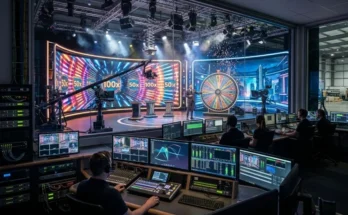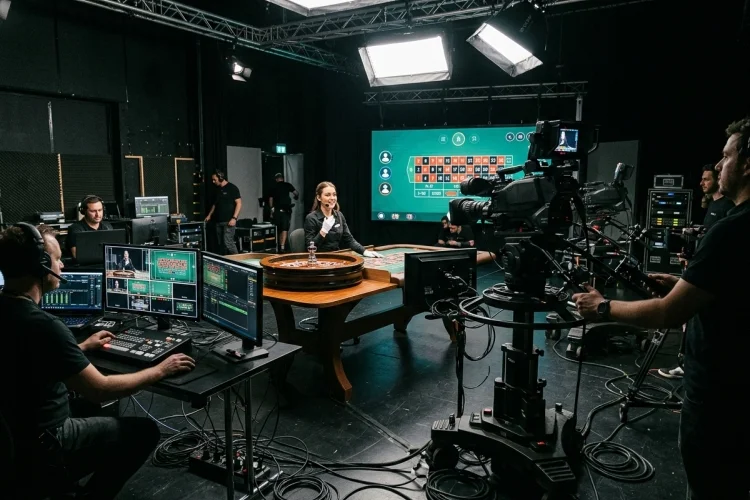
A live casino table might look simple on your screen: a dealer, some cards or a roulette wheel, betting controls, and a video feed.
Behind that interface is a surprisingly complex production setup that combines casino operations with television-style broadcasting.
Understanding How Live Casino Tables Are Filmed and Broadcast reveals how cameras, studio lighting, trained dealers, game software, surveillance, and streaming systems work together.
Unlike a normal video call, the system must deliver live pictures while also recording bets, recognizing game events, displaying results, and keeping the entire table synchronized for online players.
Live Casino Tables Operate Inside Broadcast Studios
Many online live dealer games are produced inside dedicated studios rather than on ordinary public casino floors.
These environments combine the appearance of a casino with the technical infrastructure of a television studio.
Evolution describes its live casino facilities as advanced TV and film-style studios equipped with interior sets, professional lighting, multi-camera systems, audio equipment, and IT technology. Games can be broadcast in real time for extended hours depending on local regulations and operator availability.
The dealer sits or stands at a physical gaming table, while players connect remotely through phones, tablets, or computers.
Behind the visible set are production systems that manage video, game information, connections, and table supervision.
Why Several Cameras Are Used
A single camera could technically show the dealer and table, but modern live casino production often uses several.
Different camera angles make the game easier to follow and can provide close-ups when important events occur.
A roulette broadcast might show a wide view of the dealer, a close-up of the spinning wheel, and another angle focused on the ball.
Blackjack cameras may highlight cards and the dealer’s actions.
Evolution’s Immersive Roulette is an extreme example. The game uses multiple cameras positioned around the table and dealer, including high-frame-rate video designed to capture the roulette ball closely and provide slow-motion views.
Most standard tables are less cinematic, but the same basic idea applies: camera placement helps make physical casino actions clear on a digital screen.
Lighting Is More Important Than It Looks
Studio lighting does more than make the dealer look professional.
Cards, roulette numbers, chips, and table markings must remain clearly visible on camera.
Poor lighting could create glare on playing cards or reflections on a roulette wheel. Excessive shadows might make important details harder to identify.
Broadcast studios therefore use controlled lighting rather than relying on ordinary ceiling lights.
The background also needs to remain visually balanced. Too many bright elements can distract from the table, while overly dark lighting can make the stream look unclear.
Evolution specifically describes its studio environments as combining designed décor with atmospheric lighting and professional broadcast technology.
This carefully controlled enviroment makes the game easier to watch across different screen sizes.
Dealers Are Part Dealer and Part Presenter
Live dealers do more than distribute cards or spin wheels.
They are also on-camera presenters.
A dealer must explain actions clearly, maintain the correct game pace, follow dealing procedures, acknowledge player interaction, and remain comfortable in front of cameras.
Evolution’s current dealer recruitment materials describe the role as a combination of live casino dealer, on-camera host, and customer-service professional. Dealers receive training before working on live tables.
Training is also important from a regulatory perspective.
The UK Gambling Commission’s live dealer standards state that croupiers should receive adequate training to provide games fairly according to documented procedures and game rules. Evidence of training and refresher training should also be maintained.
So the dealer’s presentation may look relaxed, but the procedures behind it are highly structured.
What Happens When a Round Starts?
A live casino round usually begins with a defined betting period.
Players select their bets through the digital interface while the physical dealer prepares the game.
In roulette, wagers close before the final result is determined. In blackjack or baccarat, the cards are then dealt according to the table rules.
The live video shows the physical action, while the software interface manages the player’s electronic wagers.
Those two systems need to remain synchronized.
If a roulette number wins, for example, the result shown in the interface must correspond with the number physically produced by the wheel.
The gaming system then settles qualifying bets according to the published rules.
Although players mostly see the dealer, a considerable amount of technical processing happens behind the scenes during every round.
How Physical Results Become Digital Information
The most interesting part of a live casino setup is the connection between the physical table and the digital interface.
A player watching roulette needs the winning number to appear electronically. Blackjack software needs to know which cards are in play. Baccarat systems need to track dealt cards and calculate the hand result.
Providers can use several technologies to help capture game events, including sensors, card-reading systems, specialized hardware, and optical recognition systems depending on the game.
The exact technology varies by provider and product.
What matters is that the physical outcome and digital result remain aligned.
The UK Gambling Commission requires live dealer operations under its standards to be fair and independently auditable. It also requires monitoring of operational equipment and documented procedures for table integrity.
This makes accurate result capture far more than a visual convenience.
Why Surveillance Cameras Are Separate From Broadcast Cameras
The cameras shown to players are not necessarily the only cameras inside the studio.
Production cameras are designed to create the live broadcast.
Surveillance systems serve a different purpose.
The UK Gambling Commission’s RTS 17 guidance says live dealer gaming areas should have video surveillance capable of recording dealer activity in enough detail to verify whether dealing procedures and game rules were followed.
That footage supports auditing and incident investigation.
For example, if there were a dispute about whether a card had been handled correctly, recorded surveillance could help investigators reconstruct what happened.
Studio operations can also include supervisors who watch table activity and equipment.
So while the player may see one clean cinematic view, the studio itself can be monitored from several additional angles.
How the Video Reaches Online Players
Once cameras capture the action, the video feed must be encoded and transmitted through streaming infrastructure.
The stream is then delivered to the casino platform, where the video appears alongside betting controls and account information.
Players may connect from many different devices and network conditions, so the platform must cope with different screen sizes and connection speeds.
Evolution describes its live games as broadcasts that players access through phones or computers, with the software interface allowing wagers, decisions, and dealer chat alongside the live video.
This combination is important.
The video stream shows what is happening physically, while the interactive software handles what the player is doing digitally.
Neither part works alone.
Latency Has to Be Managed Carefully
Every livestream has some delay.
The video must be captured, encoded, transmitted, decoded, and displayed. Meanwhile, a player’s bet or game decision must travel back to the platform.
This delay is called latency.
For games with time-sensitive actions, even relatively small delays can become important.
The UK Gambling Commission requires operators to assess situations where network latency or device performance could significantly disadvantage customers in time-critical events. Players should also be informed about relevant technical risks.
That is one reason live games use clear betting countdowns.
Players should avoid waiting until the final second to submit an action, especially when their internet connection is unstable.
The Studio Is Built Around Game Integrity
A live dealer studio is not simply a television set with casino decorations.
The equipment, tables, cards, wheels, procedures, and staff all form part of the gaming operation.
UK regulatory guidance states that equipment and consumables should be of commercial casino quality and that designated staff should monitor equipment integrity. Secure areas should also be protected so only authorized personnel can access them.
Game logs are another part of the system.
The same guidance recommends maintaining game logs and analysing event statistics for trends relating to game performance, staff, or gaming locations.
These controls explain why professional live casino production is considerably more complex than simply pointing a webcam at a blackjack table.
Live casino broadcasts combine real gaming equipment with television-style production and interactive software.
Multiple cameras capture the dealer and table, studio systems process game events, streaming technology sends the video online, and surveillance supports game integrity.
The next time you watch a live table, look beyond the main camera. Behind that simple screen is an entire broadcast and gaming infrastucture working in real time.