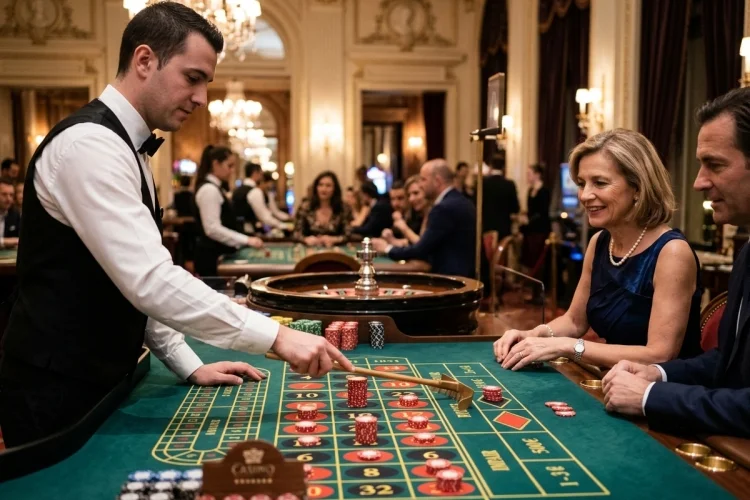
Zero is normally bad news for an even-money roulette bet. If you place chips on red and the ball lands on the green zero, the wager usually loses. French Roulette can handle that situation differently through a rule called La Partage.
Understanding How the La Partage Rule Works is useful because it changes the mathematics of several common wagers without changing the roulette wheel itself.
Instead of losing the entire stake when zero appears, players on qualifying bets lose only half, reducing the long-term house advantage.
What Is the La Partage Rule?
La Partage is a special roulette rule associated mainly with French Roulette. The French phrase roughly means “the sharing” or “the division.”
The idea is straightforward. If the ball lands on zero while you have an eligible even-money wager, the casino takes half of your stake and returns the other half.
Evolution describes French Roulette as using a single-zero wheel with numbers 1–36 plus zero. It explains that La Partage applies when an even-money bet is active and the ball lands on zero.
That small adjustment matters because zero is the outcome responsible for much of the casino’s mathematical advantage on a single-zero roulette wheel.
Which Roulette Bets Qualify?
La Partage does not apply to every bet on the table.
It normally covers the three main categories of even-money wagers: Red/Black, Odd/Even, and Low/High, meaning 1–18 or 19–36.
These bets normally pay 1:1 when they win.
A straight-up number, split, street, corner, dozen, or column does not usually receive the half-back protection. If zero lands while you have one of those bets, the wager is settled according to the normal roulette rules.
Pragmatic Play’s French Roulette similarly describes La Partage as returning 50% of a 1:1 bet when zero lands.
This distinction is important because the reduced house edge applies only to qualifing wagers, not every chip placed on a French Roulette table.
A Simple La Partage Example
Imagine placing $20 on black.
If the ball lands on one of the 18 black numbers, the bet wins at 1:1. You keep the original $20 stake and receive $20 in winnings.
If a red number appears, the $20 stake loses.
Now suppose zero lands.
At a normal single-zero roulette table without La Partage, you would lose the entire $20. With the rule active, only $10 is lost and the remaining $10 is returned.
There is no additional spin and no winning payout. The wager is simply divided in half.
That immediate settlement is one reason La Partage is relatively easy to understand compared with some other French roulette rules.
Why Zero Creates the Roulette House Edge
An even-money wager can look like a 50/50 proposition at first.
There are 18 red numbers and 18 black numbers. Likewise, there are 18 odd and 18 even numbers.
The problem is zero.
A European or French single-zero wheel contains 37 pockets rather than 36. Zero is neither red nor black, neither odd nor even, and neither within 1–18 nor 19–36.
Therefore, a red wager wins on 18 of 37 possible outcomes rather than 18 of 36.
Without La Partage, the standard single-zero roulette house edge is 1/37, or roughly 2.70%. Wizard of Odds gives the same figure for a 37-number single-zero wheel.
La Partage changes only what happens during that zero outcome.
How La Partage Reduces the House Edge
The mathematics are surprisingly simple.
For a $1 even-money wager, 18 numbers produce a $1 profit and another 18 produce a $1 loss.
One remaining result—zero—creates a $0.50 loss under La Partage.
The expected value can therefore be represented as:
(18/37 × $1) − (18/37 × $1) − (1/37 × $0.50)
The first two amounts cancel each other out. What remains is a theoretical loss of $0.50 for every 37 units wagered.
That equals approximately 1.35%.
Wizard of Odds calculates the house edge for the French half-back rule at roughly 1.35% on applicable even-money bets.
Another way to express it is an approximate theoretical RTP of 98.65%.
This does not mean somebody will actually lose exactly 1.35% during a short roulette session. House edge describes a long-term mathematical expectation across a very large number of wagers.
La Partage vs Normal European Roulette
French and European Roulette generally use the same basic wheel: 37 pockets consisting of numbers 1–36 and one zero.
The main difference appears in the treatment of qualifying even-money bets.
At a standard European table without La Partage, zero causes the full wager to lose. The resulting house edge is approximately 2.70%.
At a French table with La Partage, zero causes only half of an eligible wager to be lost. That reduces the mathematical edge to approximately 1.35% for those particular bets.
Casino.com’s updated French Roulette guide also identifies La Partage as one of the main rules separating French Roulette from standard European Roulette.
The wheel itself has not become more favourable. The difference comes from how one specific result is settled.
La Partage vs En Prison
La Partage is often mentioned alongside another French Roulette rule called En Prison.
Both begin with the same situation: zero appears while an even-money bet is active.
La Partage settles the result immediately. Half of the wager is returned and half is lost.
En Prison instead holds the wager for another spin under the table’s stated rules. If the next result satisfies the imprisoned bet, the stake may be released rather than generating an ordinary profit.
What happens if zero appears again can vary between rule sets. Wizard of Odds documents several possible imprisonment procedures, showing why players should not assume all En Prison implementations are identical.
In practical terms, La Partage is the more straightforward of the two because there is no seperate settlement spin.
Does La Partage Apply to American Roulette?
Traditionally, La Partage is associated with single-zero French Roulette rather than standard double-zero American Roulette.
American Roulette normally contains 38 pockets: numbers 1–36, zero, and double zero.
That additional pocket increases the standard house edge on most bets to approximately 5.26%.
Evolution’s roulette documentation distinguishes French Roulette’s single-zero La Partage format from American Roulette’s additional 00 pocket.
Some casinos have historically offered special half-back rules on double-zero tables, but those should not automatically be treated as traditional French La Partage.
Always read the individual table conditions rather than relying only on the roulette variant’s name.
Why You Should Check the Game Rules
Not every single-zero table offers La Partage, and not every game marketed with a French-style layout necessarily handles every special rule identically.
Look for an information panel describing what happens when zero appears.
It should state which even-money bets qualify and whether the table uses La Partage, En Prison, or another procedure.
The UK Gambling Commission requires applicable remote-game rules to be easily available before customers gamble. Relevant information can include the house edge, RTP, probabilities, payouts, and explanations of how the game operates.
That makes the rules screen more reliable than simply assuming a French-looking table includes every traditonal feature.
Common Misunderstandings About La Partage
One common mistake is assuming La Partage makes zero a winning outcome. It does not.
Zero still produces a loss on a qualifying even-money wager—the loss is simply reduced to half the stake.
Another misunderstanding is that the 1.35% house edge applies to the entire roulette table.
It does not normally apply to straight-up bets, corners, splits, dozens, or columns. Those retain the usual mathematics of a single-zero wheel.
Finally, the rule does not predict future spins or provide a system for determining which colour will appear next.
It changes the settlement of one outcome. It does not alter how the ball decides where to land.
La Partage is a simple rule with a clear mathematical effect: when zero lands on a qualifying even-money wager, half the stake is returned instead of the entire bet being lost. That lowers the theoretical house edge from about 2.70% to roughly 1.35% on those bets.
Before playing French Roulette, check the table rules and confirm exactly which wagers receive La Partage protection.